UNIMAC · Humanitarian Localisation · Bamenda, Northwest Region · April 2026
The Future of Humanitarian Work in Cameroon Will Be Local
And the organisations that understand this transition today will define humanitarian response tomorrow. UNIMAC is already moving.
UNFPA Technical Working Group — Bamenda·
Northwest & Southwest Regions, Cameroon·
8 min read
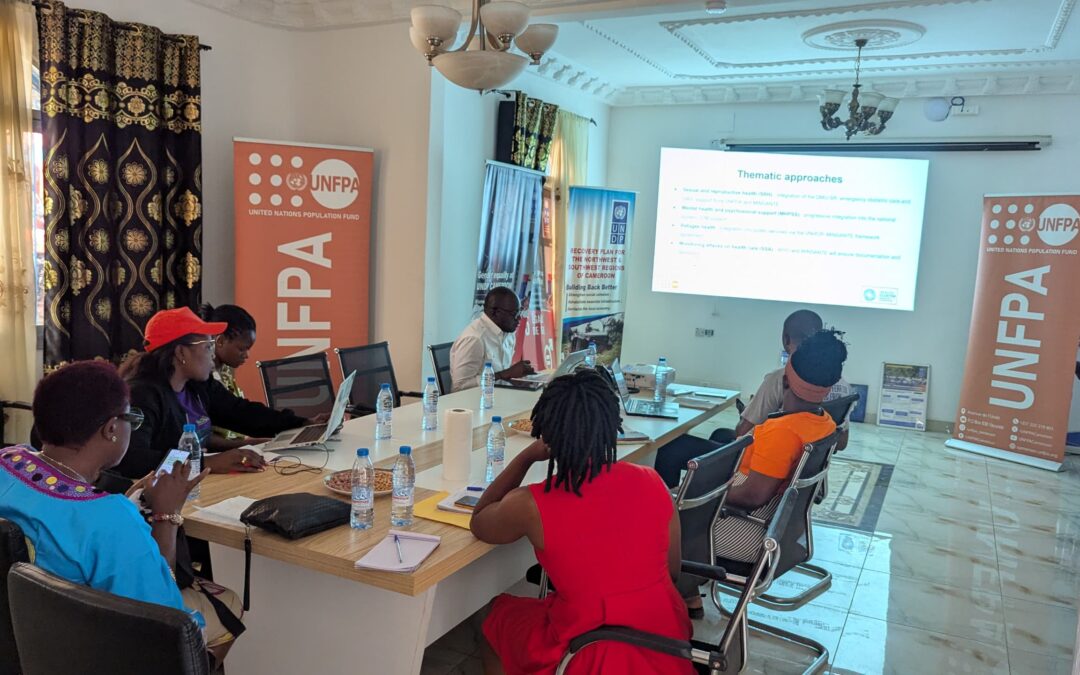
For decades, humanitarian response in Cameroon has been architected at distance — international frameworks, centralised planning, external coordination cycles that move more slowly than the crises they address. A fundamental shift is now underway. On 29 April 2026, UNIMAC sat at the table where that shift is being operationalised.
A meeting with structural consequences
UNFPA’s Technical Working Group meeting in Bamenda was not a consultation event. It was a working session convened around one of the most consequential strategic questions in Cameroonian humanitarian programming: how to transition from centralised, externally-driven response systems toward locally-led interventions that are faster to deploy, better calibrated to community realities, and sustainable beyond the funding cycle that created them.
The Northwest and Southwest regions — both carrying the persistent weight of displacement, restricted healthcare access, and acute vulnerability among women and girls — were the primary focus. These are not hypothetical contexts. They are environments where the gap between decision-making authority and lived experience has, in some cases, cost lives.
Event
UNFPA Technical Working Group (TWG) Meeting
Date
29 April 2026
Location
Bamenda, Northwest Region, Cameroon
Focus
Humanitarian localisation — Northwest & Southwest Regions
UNIMAC Representative
Ms. Carista Kenfak Nkwenti
Strategic Theme
ABC approach to community-centred humanitarian response
The humanitarian pressures driving this shift
The Northwest and Southwest regions carry an exceptional humanitarian burden. Five overlapping pressure points define the operating environment — and each one exposes the limitations of centralised response architectures.
Sexual and reproductive health services are typically among the first systems to collapse under humanitarian pressure — overwhelmed infrastructure, disrupted supply chains, displaced health workers — and among the last to recover. In communities where these services are already structurally thin, a crisis does not merely strain the system. It eliminates it entirely.
Centralised response systems, by their nature, are not designed to move at community speed. Local actors are. That is the operational reality underpinning the localisation agenda — not an ideological preference, but a functional requirement.
Communities facing crisis are not passive recipients waiting for external solutions. They carry the deepest knowledge of their own realities — and the most direct incentive to address them. Localisation is the act of finally putting that knowledge to work.
The ABC approach: what it means in practice
The meeting centred on a more localised “ABC approach” — a framework designed to reposition community organisations as the primary actors in humanitarian planning and implementation, rather than subcontractors within externally-designed programmes.
What genuine localisation actually requires
“Localisation” has become one of the most misused terms in the humanitarian sector — invoked to describe arrangements where international actors retain decision-making control while local organisations absorb implementation risk. The TWG meeting in Bamenda was explicit about what genuine localisation demands.
- →Strengthened NGO coordination: Reducing fragmentation and duplication among organisations operating in the same communities, replacing parallel delivery with genuine shared systems.
- →Improved data sharing: Creating the information infrastructure that allows actors to make decisions based on shared intelligence rather than siloed assessments.
- →Active NGO mapping: Maintaining an updated, accurate picture of which organisations are operational in which areas — the foundation of any coordinated response system.
- →Community ownership: Moving communities from consultation targets to co-designers of the interventions that directly affect them.
These are not aspirational commitments. They are identifiable system failures whose correction would improve humanitarian effectiveness in measurable ways. Poor coordination wastes resources. Weak mapping produces duplication. Disconnected data systems produce decisions detached from ground reality. Fixing each one has a concrete downstream impact on the people these systems are designed to serve.
UNIMAC’s strategic position in this transition
UNIMAC was represented at the TWG by Ms. Carista Kenfak Nkwenti, who reaffirmed the organisation’s commitment to supporting vulnerable women and girls — with particular emphasis on sexual and reproductive health in humanitarian emergency contexts. That emphasis is strategically significant: SRH is precisely the service category most exposed to collapse during crises and most dependent on locally embedded actors for restoration.
Community-embedded engagement
Grassroots coordination capacity
SRH vulnerability response
Multi-partner delivery
Women & girls protection focus
Northwest Region field presence
UNIMAC’s presence at this meeting signals something more significant than participation in a single TWG session. It signals a deliberate organisational positioning: not as a passive recipient of international aid architecture, but as a local implementation actor with the capability, field presence, and institutional credibility to lead in the model the humanitarian sector is transitioning toward.
Organisations present in these spaces — that contribute to the design of coordination systems, that build relationships with UNFPA and peer NGOs before a crisis requires it — will be structurally positioned when funding flows toward locally-led models. Those that are not present will be structurally excluded, regardless of their ground-level capability.
What the meeting produced
Four concrete outcomes emerged from the Bamenda TWG session — each contributing a specific building block to the localisation architecture under construction.
Why the funding community should be paying close attention
The global humanitarian funding landscape is shifting in ways that are already visible in donor strategy documents and will become structurally determinative within the next programming cycle. Funders are not merely preferring locally-led interventions — they are beginning to require them as a condition of disbursement.
Organisations that understand and are actively positioning for this transition — building institutional relationships, contributing to coordination architecture, demonstrating SRH expertise in crisis contexts — will become the preferred implementation partners of the next funding generation. UNIMAC is not on the periphery. It was in the room in Bamenda on 29 April. It will be in the rooms that follow.
Humanitarian response cannot remain dependent on distant decision-making while communities carry the consequences in real time. The organisations closest to the people must become central to the solution — and the institutional architecture to make that happen is being built now, in meetings like the one UNIMAC attended in Bamenda on 29 April.
UNIMAC is an active member of the UNFPA Technical Working Group for the Northwest and Southwest Regions of Cameroon. For partnership, funding, or coordination enquiries, contact UNIMAC through official channels.